Update, Partner and Innovate — AUTM Eastern Regional Meeting

I will be on a panel entitled “Kicking the Hornet’s Nest – Patenting Early Stage Technology” at the AUTM Eastern Regional Meeting in Baltimore (May 24th). I will be joined by Esther Kepplinger, Director of Patent Operations at Wilson Sonsini and Dr. Kathryn R. Doyle of the Riverside Law Group. We will cover new developments in patenting DNA, claiming diagnostic methods and what the full-term written description requirement of Ariad v. Lilly means to your patenting strategy. How is isolated DNA different than a gold nugget? How is a diagnostic method like Murphy’s Law? Can you still get a mechanism-of-action claim? Your panel of experts will answer these questions and more.  Y’all come!
Posted in Conferences and Classes | Tagged , , , , | Leave a comment

Fixing The Holes – Proposed Amendment De-Bugs Grace Period

Today, a Manager’s Amendment to H.R. 1249, the “Patent Reform Bill” was circulated that exempts all disclosures made by the inventor from patent defeating activities, if they are made within one year of filing on the invention. In other words, the patent-defeating activities that the inventor can duck are when the claimed invention was “patented, described in a printed publication or otherwise disclosed to the public before the effective filing date.” As noted by Hal Wegner (see below), this wording in the bill effectively overrules Metallizing Engineering, a 2d Cir., Learned Hand opinion handed down in 1946 which barred inventors from patenting who secretly commercialized their inventions for more than a year prior to filing, since such activities are not patent-defeating acts under the new  first-to file provisions of the act.

From Hal Wegner:

Today, House Judiciary Committee Chairman Lamar Smith circulated a Manager’s Amendment to the America Invents Act, Smith, H.R. 1249, which is designed, inter alia, to maintain the grace period versus the patent applicant’s pre-filing commercialization of the invention.

Continue reading

Posted in Patent Reform Legislation | Tagged , , , , , , , , , | Leave a comment

Patent Reform Bills – Grace Period A Mixed Blessing

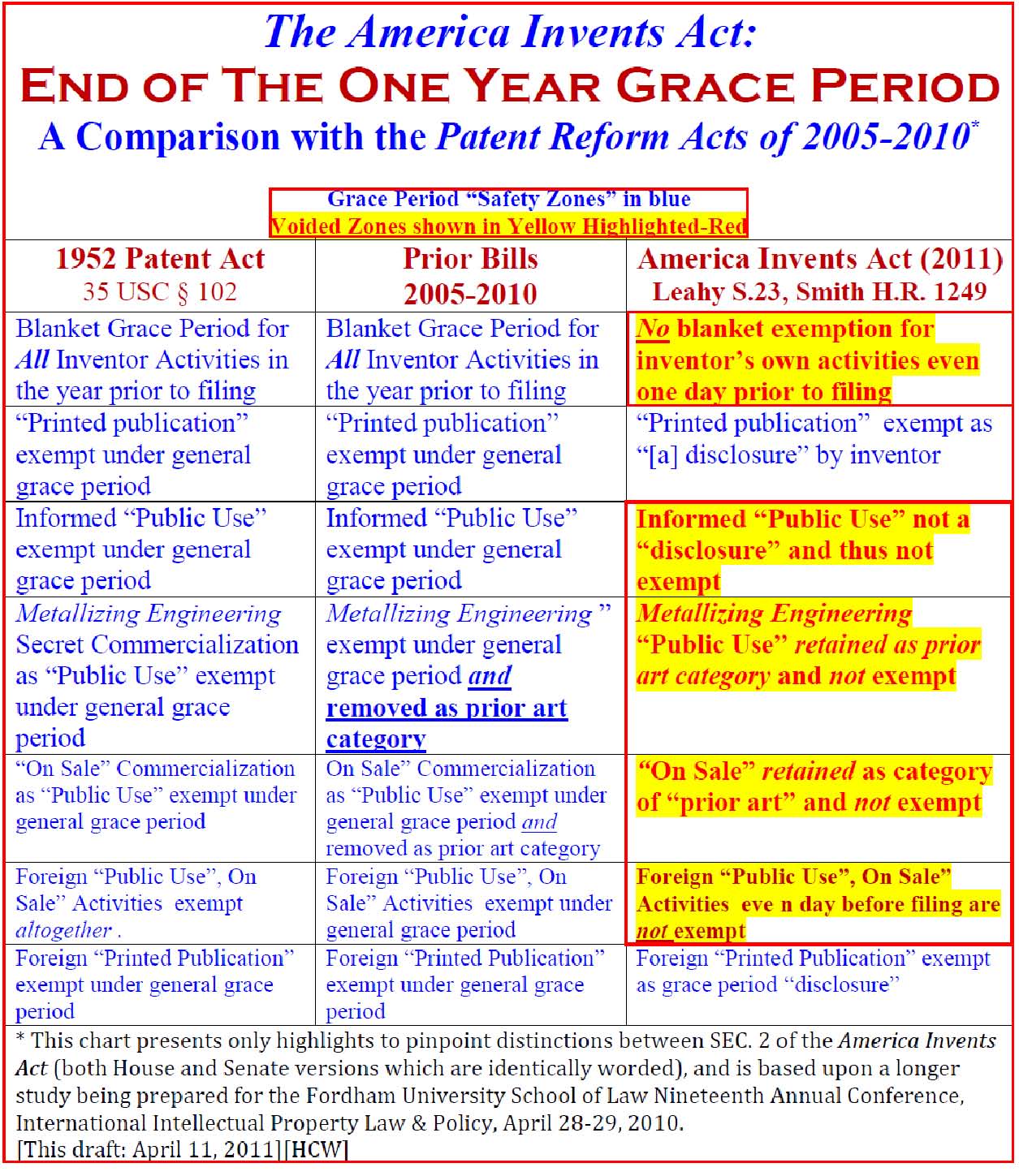
Hal Wegner writes to summarize the “holes” in the grace period for activities by the inventor, as present in both bills. If you support these reform bills, at least be sure you know what you and your clients will be getting and what protections will vanish. I remain surprised that organizations that represent university inventors and tech transfer offices remain committed to passage of the current bills. I guess that a grace period for “printed publications” (including posters) is better than none, but what about slideshows and other primarily oral presentations given at meetings (often with brief, uninformative abstracts)? What about the oral thesis defense or grad school seminar that is legally open to the public? In other words, when does a “disclosure” by an inventor that is not a printed publication become a “public use”?Policing disclosures originating at universities is about to  get a lot more difficult.

According to Mr. Wegner, the chart shown below — and also available as a PDF — “only represents the tip of the grace period iceberg which is analyzed in more detail in a study to be released for the Fordham University School of Law Nineteenth Annual Conference,  International Intellectual Property Law & Policy, April 28-29, 2011. ”

GracePeriodChartApr11

Posted in Patent Reform Legislation | Tagged , , , , , , , , , , | Leave a comment

Myriad Oral Arguments – Section 101 vs. Chemistry 101?

After listening to the IPO webinar and reading the detailed account by Kevin Noonan in PatentDocs on the Myriad oral arguments, I was somewhat heartened to “hear” the Fed. Cir. panel moving toward “getting it” regarding what an isolated DNA sequence is. This should not be an issue that requires great debate, but it seems like it was. Not surprisingly, Judge Lourie, a chemist, got it right away, when he addressed the issue of the difference between the patent-eligibility of a new mineral found in the earth and an isolated DNA sequence:

“The mineral is still the mineral when it’s attached to the rock and just physically compressed, it’s not chemically joined as a different molecular substance. Whereas your gene is simply different in the isolated state from what it is in situ…It’s a different material because you have broken covalent bonds.”

Right on! But at this point, Myriad’s attorney, Greg Castanias – who is not a scientist as far as I can tell – wandered off on a tangent about the “complex efforts” it takes to isolate a gene – a point completely irrelevant to the 101 arguments. Despite the diversion, Judge Bryson seems to be the next panelist who got Judge Lourie’s distinction. As described by Kevin Noonan: “Judge Bryon asked if the argument was to distinguish between a mineral that was isolated by ‘breaking covalent bonds’ from a mineral that was purified by, for example, “washing it with a solvent to remove impurities”[like the gold nuggets that the ACLU is always using as an analogy for DNA]”.

Continue reading

Posted in Patent Eligible Subject Matter | Tagged , , , , | 2 Comments