
Otsuka v. Sandoz – Motivation Trumps Structure

The recent decision of the Fed. Cir. in Otsuka v. Sandoz, App. No. 2011-1126, -1127 (Fed. Cir. May 7, 2012) continues the courts admirable work in defining obviousness post-KSR. This case revisits the standards involved in making out a prima-facie case of structural obviousness. What is particularly interesting in this decision is the weight – or lack thereof – that the court gave to evidence of therapeutic utility of the closest prior art compound. In fact, the court applied the fairly obscure maxim of patent law articulated forty years ago In re Steminski, 444 F.2d 581 (CCPA 1971). John L. White, in Chemical Patent Practice, summarized the holding of Steminski as part of his discussion of the “Hass-Henze Doctrine”:

“The [CCPA] concluded that because the characteristics normally possessed by members of a homologous series [e.g., differing by only one methylene group] are principally the same, varying gradually from member to member [e.g., methyl, ethyl, propyl, butyl, etc], chemists knowing the properties of one member of a series would in general know what to expect in adjacent members so that a mere difference in degree is not the marked superiority which will ordinarily remove the unpatentability of adjacent homologs of old substances. Contra, where no use for the prior art compound is known [citing Steminski].”

Continue reading

Posted in Obviousness | Tagged , , , | Leave a comment

Prometheus Q/A Results: Does Patent Eligibility Impact Biotech Research?

A guest post from shareholder Robin Chadwick of SLW.

A quick survey of folks who read this blog indicates that funding for 5

0% of respondents’ R&D is affected by whether or not a project was patentable. Similarly, 50% of respondents report that aspects of R&D are modified by whether their R&D is patentable.

Most of those who responded were involved in the business of diagnostic methods (95%), recombinant technology (81%) and/or nucleic acids or proteins (90%).

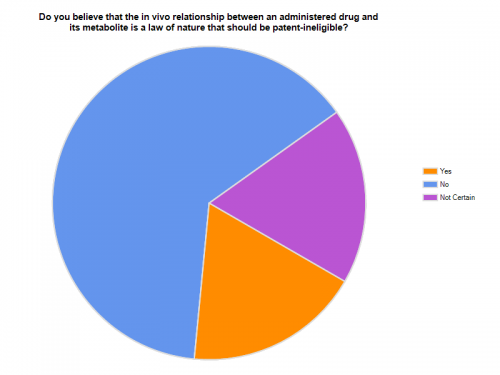
Sixty-four (64%) of respondents stated that diagnostic method claims should be eligible for patenting when drawn to an in vivo relationship between an administered drug and its metabolite concentration.

Continue reading

Posted in Patent Eligible Subject Matter | Tagged , , , | Leave a comment

Fed. Cir. Orders Briefing in Myriad Remand

On April 30th, in response to the Supreme Court’s GVR of the Myriad appeal (AMP et al. are still trying to get the claims to isolated DNA molecules and the use of a transgenic cell comprising the BRCA1 gene to screen potential anti-cancer drugs—claim 20– declared patent-ineligible as natural products or natural phenomena), the Fed. Cir. vacated its original decision and requested the parties and amici to brief the question: “What is the applicability of the Supreme Court’s decision in Mayo to Myriad’s isolated DNA claims and to method claim 20 of the ‘282 patent?”

Although many trees will die to make the paper for the tower of briefs that will undoubtedly be filed, I present the answers for your convenience:

Question part 1: None whatsoever. The Supreme Court considered method claims and the DNA claims are compound (composition of matter) claims.

Question part 2: None whatsoever. The Supreme Court did not purport to reverse Chakrabarty, which claimed the use of transgenic cells containing plasmids that enabled them to degrade oil. In fact, the Court purported to rely upon it extensively. See slip. op. 1-2. Myraid’s claim 20 is no more than a claim to the use of novel transgenic cells of the same “class.” If a composition of matter is novel, so are any and all of its uses. I still have a file folder labeled “The Death of Durden.” See In re Ochiai. The end.

Myriad Court Order


Posted in Patent Eligible Subject Matter | Tagged , , , , , | 1 Comment

Sherley v. Sibelius – The Undead Threat To Stem Cell Funding

Hand emerging from the groundWhen a three judge panel of the US Court of Appeals for the D.C. Cir. dismissed a preliminary injunction obtained by plaintiffs in April 2011, and the lower court judge then  dismissed plaintiffs’ suit to block the Administration’s guidelines permitting funding for embryonic stem cell research as violative of the Dickey-Wicker amendment banning funding that might destroy or harm a human embryo, I thought the issue had been laid to rest. However, plaintiffs – not the Government – have now appealed to the appeals court, arguing that the prior ruling overturning the injunction banning hESC research is not binding on the present panel.

The earlier panel had ruled that the  Dickey-Wicker amendment, that is tacked onto some bill sure to pass Congress each year, is ambiguous in view of the more precise policies urged by the Administration and the NIH, regulating hESC research. The plaintiffs argued that the earlier panel ruling simply involved injunctive relief and should not be “the law of the case” regarding the merits of their suit. Defendants and amici argued that the panel effectively analyzed the merits of the suit: the conflict or congruence between Dickey-Wicker and the NIH policy resuming funding for stem cell research.

If the current panel does not agree that it is bound by the earlier panel’s analysis and sides with the (anti-hESC research) plaintiffs, this case will wend its way to the Supreme Court. However, if the Administration changes in November, and a new Administration reinstates the “Bush ban,” the appeal will be moot. Those who support hESC research should hope that the stem cell researchers can get some grants funded and new cell lines approved  in the next six months or so. A pro-science door that has been open for about three years may be about to close.

Read the article from Regenerative Medicine Forum

Prior posts on this subject can be found here:

July 28, 2011

May 2, 2011

Posted in Stem Cells/Cloning | Tagged , , , , , , , , , , , , , , , | Leave a comment